
If Chinese Medicine isn’t looking for the cause, why does it have answers that Western Medicine will never find?
Chinese Medicine concerns itself with the relationship between variables and whether these are harmonious or not.
Symptoms = Disharmony
The Big Divide
In Western medicine it’s not uncommon to hear or be told that doctors do not know why symptoms aren’t improving or are getting worse or even begun in the first place. Western medical philosophy is steeped in germ theory and concerned with isolable diseases that can be supressed, controlled or destroyed using pharmaceutical interventions. i.e. cause and effect, a linear relationship between two things. Western medicine begins with a symptom and then searches for the underlying mechanism so that a drug can be selected to quieten the symptoms and ‘treat’ the patient. When these drugs stop quietening the symptoms, stronger ones are prescribed often alongside other drugs to counter the side effects of the initial drugs until eventually nothing works and 'treatment' comes to an end. This is where we find the first big difference between Western medical philosophy and Chinese Medicine.
Chinese Medicine has no interest in the precise cause of symptoms. Rather than asking ‘did X cause Y’, Chinese Medicine is concerned with the relationship between X and Y and if it's working harmoniously, and if it isn’t, then you fix it. Chinese Medicine looks at the person’s whole configuration and for patterns of disharmony or places of imbalance within the body and targets these. In Chinese Medicine the question of cause and effect is always secondary to the overall pattern of disharmony within the body that needs to be reestablished. Treatment is centred on restoring harmony and bringing the individuals ‘configuration’ back into balance so that the body can heal itself. Symptoms are usually the reason why people seek help and are a vital piece of the puzzle for any medical system. Whereas Western Medicine seeks to suppress symptoms, Chinese Medicine seeks to restore underperforming relationships within the body so that the body heals itself.
Yin and Yang – The logic underlying Chinese Medical Theory
Yin and Yang theory lie at the heart of harmonious patterns and relationships within the human body and the external world according to Chinese Medicine. In Chinese Medicine, a part can only be understood in its relation to the whole. What does this mean? Yin and Yang are convenient labels for describing how things function in relation to each other and to the universe. They are used to explain the continuous process of natural changes as well as a way of thinking. In this system, no single entity can be isolated from its relationship to other entities and nothing can exist by itself.
Yin and Yang co-exist and bring about balance, opposition, change and control. Think about it like a self-regulating system which if left alone will find its own equilibrium, its own harmony. The concept is easier to conceptualise using examples that describe their characteristics. When something is described as Yin, think about it as the shady side of a slope with qualities such as cold, at rest, responsiveness, passivity, darkness, interiority, downwardness, inwardness, decrease, satiation, tranquillity, and quiescence. Yin captures the end, the completion and realised fruition. Yang on the other hand can be considered the sunny side of the slope emboding characteristics associated with brightness, heat, stimulation, movement, activity, excitement, vigour, light, exteriority, upwardness, outwardness, and increase. It is arousal and signifies beginnings and dynamic potential. All of these Yin and Yang characteristics are part of all normal organic processes. As the sun moves in the sky what was the shady sides becomes the sunny side and vice versa, it signifies that everything is always in a process of change or transformation.
Yin and Yang are always subtly supporting , repairing, and transforming into one another This constant transformation is the source of all changes, a continuous give and take relationship. Examples include inhalation and exhalation and periods of activity and exertion followed by periods of nourishment and rest. When the relationship between Yin and Yang is unbalanced for prolonged periods of time or in an extreme manner it leads to disharmony where the deficiency of one is unable to support the excess of the other. So then something has to give. Chinese Medicine suggests 3 possible outcomes: 1. Yin and Yang are rebalanced through treatment and healing, 2. One transforms into the other since at the extremes Yin will become Yang or Yang will become Yin, a bit like an escalation or a deterioration into a more serious situation where radical transformation occurs such as when a person suffering from fever (considered an excess of Yang) is at risk of going into shock (considered an extreme Yin or cold condition), or 3. The cessation of existence e.g. death or the ending or a relationship for example.
What is Qi and Why does it matter?
Apart from Yin and Yang, there is no concept more crucial to Chinese Medicine than that of Qi. So what is Qi? Qi is similar to the concept of Prana in Ayurveda although it is much broader. Qi is an energy that pervades the whole body and loosely translates to life force or vital energy, a key concept in Naturopathic medicine. It is the quality of our Qi that determines our vitality and overall health and resilience to disease. It is the force that nourishes both body and mind and it needs to be able to flow freely throughout the body in order to maintain optimal health. Imbalances of Qi are described in Chinese Medicine as blockages, stagnation, deficiency or excess and considered to cause dis-ease. A good diet, full of organic pesticide free produce will be full of nutrients and the essence of Qi.
There are 5 primary types of Qi:
-
Organ Qi – every organ has its own Qi characterised by the organ it is attached to. Organ Qi describes the vitality of that particular organ in relation to its relationship with other organs and bodily processes. Addressing organ Qi problems would be part of a client treatment plan.
-
Meridan Qi – In Chinese medicine meridians are channels or pathways through which Qi flows between the organs and various body parts adjusting and harmonising them.
-
Nutritive Qi - is associated with the blood and moves with the blood through the blood vessels helping to transform nutrients from food into blood.
-
Protective Qi – loosely relates to the immune system in Western medicine because it is responsible for resisting and combating external influences that invade the body.
-
Ancestral Qi – gathers in the chest and aids and regulates the rhythmic movement of respiration and heartbeat.
Disharmony can occur in any of these types of Qi and facilitating the creation and flow of Qi in the body is an integral part of treatment.
The 5 Internal Climates, Organ Networks and The Organ Clock
Chinese medicine distinguishes 5 internal climates influenced by emotions, environment, seasonal changes, and way of life that affect health and cause disease. The 5 internal climates are:


1. Dampness
2. Wind
3. Cold
4. Heat
5. Dryness / Summer heat
The 5 internal climates take account of the seasonal changes and is why eating and living in accordance with the seasons forms an integral part of Chinese medical philosophy. According to Chinese Medicine seasonal influences need to be respected and our diets amended accordingly to take account of how our energy is changing as we travel through the year, something that modern medicine has discounted and forgotten. An assessment of the current presenting internal climate is an important part of diagnosis and treatment. In Chinese Medicine, symptoms or health concerns will be described as conditions relating to one or more internal climates. For example, an overgrowth of yeast such as Candida Albicans occurs due to an internal climate of dampness and cold and therefore requires treatment that is dry and warming to restore balance. Certain fevers are described at hot and dry and require moistening and cooling in order to rebalance. The connection between our emotions and internal organs is another key concept of Chinese Medicine and cause of imbalance and disease. Excess or insufficiency of emotions affects the Qi and leads to disharmony and disease. Each emotion is linked to a pair of organs referred to as an organ network. Excess or deficiency of emotions causes disharmony within the associated organ network.
Since Yin and Yang is the bedrock of harmony and health in Chinese Medicine, each Yang organ has a partner Yin organ and the vitality of one is affected by the vitality of the other. Symptoms in one organ often creates symptoms in the partner organ or can be the result of problems in the partner organ.
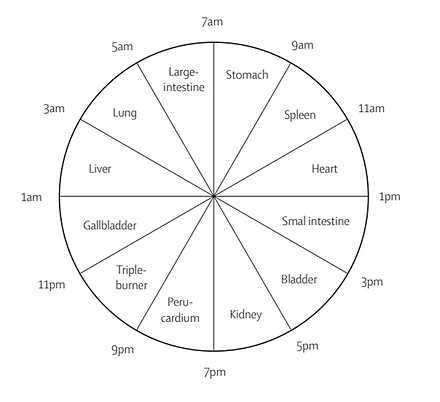
As each organ network is connected with specific emotions, it is possible to begin to understand the connection between what appears to be unrelated emotional and physical symptoms such as feeling fearful and developing a UTI. The time of day that symptoms occur is another important piece of information used by Chinese Medicine to determine which organ networks require rebalancing and when treatment would be most beneficial based on the time of day when an organ is at its strongest versus when it is at its weakest according to the Chinese Organ Clock.
Chinese Five Element Theory - Understanding 'Who Am I?'
The Yin-Yang model symbolises the creation process through the interaction of bi-polar forces, i.e. the relationship between 2 things. Chinese Five Element theory further differentiates this dynamic into a relationship between 5 fundamental powers or elements named Wood, Fire, Earth, Metal, and Water. The underlying assumption of Chinese philosophy is that the forces that govern the cycles of change occurring in the external world are duplicated within our human bodies and minds. The Five elements identify the stages of transformation, patterns of expansion and contraction, proliferation and withering. Human beings go through cycles in their lives similar to the seasons in nature, beginning in birth and ending in death with stages of growth, maturity and decay in between.
Chinese Five element theory provides a us with a comprehensive and complex schema for self-understanding. Within all of us there is a particular element that defines our ‘type’ and is the dominant element around which all the others align. Each of us has aspects of all five elements but one element will be dominant and will encapsulate our most typical behaviours, responses, reactions, feelings, emotions, and attitudes. Before we look at the relationship between the elements, how they are controlled and supported, have a look at the following brief descriptions of each and see if you can identify your type:
Wood - The Pioneer

Characteristics - Challenges & Contradictions:
-
Wants to be in charge yet misses the companionships of equals
-
Yearns to do and to act yet is subject to uncontrollable impulses
-
Makes rules yet likes to break them
-
Demands freedom yet needs to struggle
Emotions: Anger, Frustration
Organs: Liver & Gallbladder
Fire - The Wizard

-
Desires contact and intimacy yet needs solitude
-
Loves sensation and feeling yet fears being overwhelmed by intensity
-
Loves to say yes and can’t say no
-
Yearns for fusion but dreads dissolution
-
Lives in the moment and dreads the future
Emotions: Joy, Elation, Excitement
Organs: Heart & Small Intestine, Triple Warmer & Pericardium
Characteristics - Challenges & Contradictions:
Earth - The Peacemaker

-
Loves being at the still point yet feels stuck
-
Wants to be full but feels weighted down, over-stuffed and overwhelmed
-
Seeks emptiness but fears there is nothing at the core
-
Desire change yet wants to stay the same
-
Wants to be needed but wary of being absorbed and loosing self
Characteristics - Challenges & Contradictions:
Emotions: Rumination, Worry, Overthinking
Organs: Spleen & Stomach
Metal - The Alchemist

Characteristics - Challenges & Contradictions:
-
Wants relationships yet needs distance
-
Knows what is right but accepts what is safe
-
Aspires towards beauty but settles for utility
-
Wants joy yet fears spontaneity
-
Likes creativity and ingenuity yet intolerant of disorder and dissonance
Emotions: Sorrow, Sadness, Grief
Organs: Lung & Large Intestines
Water - The Philosopher

Characteristics - Challenges & Contradictions:
-
Yearns for the truth yet fears exposure
-
Yearns for connection yet intolerant of contact
-
Likes to be squeezed yet scared of being squashed
-
Wants to penetrate inside yet detests being absorbed
-
Enjoys being left alone but dreads being abandoned
Emotions: Fear, Fright, Shock
Organs: Kidney & Bladder
What’s a Causative Factor?
In the same way that we have a ‘type’ - the element that best describes our dominant characteristics, we each have an element that is our most weakest and vulnerable referred to as our Causative Factor (CF). The easiest way to identify your causative factor is by the emotion that has the most inappropriate expression. It can also be determined by the colour of the face, tone of voice, and odour omitted from the body. Have another look at the emotions associated with each element and consider which one of these emotions quickly surfaces or is the one you have the most difficulty controlling when triggered. The CF is the element within an individual that is out of balance and will cause the others to become imbalanced. Whether deficient or excessive, the CF element needs attention in order for the individual to realise internal harmony and optimal health. Have another look at the emotions against each element, can you see your most likely CF?
Sheng & Ke Cycles – the controllers of the elements
The interconnectedness of the Five Elements is illustrated by the Sheng and Ke Cycles which explain the relationships between all the elements and how they affect each other when they become out of balance. Each of the elements has a ‘mother’ and a ‘child’. The Sheng cycle also called the Support cycle depicts the mother-child relationship between the elements. The mother element is responsible for creating and nourishing the child, but an over-demanding child can drain its mother. Any element that has become deficient will fail to nourish its child or if excessive can smother or overburden its child. The Ke cycle, also called the Control cycle, explains which element controls which, a control grid that serves to prevent any one element from becoming excessive thus maintaining balance in the system.
Disharmony in one element will cause disharmony in the whole system because of the degree of interdependence between them. If one element is out of balance, the Sheng and Ke cycles determine the effect it will have on all the other elements. For example, if Wood is over saturated by its ‘mother’ element Water, then Wood becomes too wet and is unable to create Fire leading to difficulties associated with the organs related to Fire which are the heart and small intestines. The knock on effect of reduced Fire is that Fire is unable to nourish its ‘child’ Earth creating imbalances in the spleen-stomach organ network. Deficient Earth is unable to nourish its ‘child’ Water and so it goes on since this is a circular relationship rather than a linear cause and effect.

But how does an element become excessive or deficient in the first place?
This can get complicated because in Chinese Medicine everything affects everything, so bear with it! If we take a Wood ‘type’ who has a Water CF (remember this is this person's weakest element) because fear is the emotion that quickly gets out of hand and escalates causing the person to rapidly fear the worst, as fear is the emotion connected to the Water element, we would describe Water as having become exaggerated or dominant. We can then assess the impact of this on the other elements using the Sheng and Ke cycles and begin to make sense of symptoms and the best course of treatment.
According to the Sheng cycle, if the Water element has become exaggerated due to an excess of fear this can lead to destabilisation, over-nourishment or drowning of Wood causing stagnation of the liver Qi, and eventually blood, creating nervous tension, suppressed emotions and frustration and feelings of being stuck, unmotivated and unable to make decisions. If the liver and its partner organ, the gallbladder, aren’t acting in harmony then actions begin to occur without proper judgement, decisions go unactualised, or paralysis of decision and actions can occur.
According to the Ke cycle, Water controls Fire and Earth control Water. Excess Water oppresses and extinguishes Fire, the element representing fulfilment, emotional expression, thought, perception, communication, optimism, empathy, awareness and enthusiasm. This affects the heart, small intestine, triple burner and pericardium causing disturbances of metabolism, activity, and expression causing a person to become emotionally inaccessible, cold-hearted, insecure, anxious, withdrawn, confused and sensitive. If the small intestine isn’t able to separate the pure from the impure then the person may experience digestive symptoms or feelings of confusion and indecision. Excessive dampness will also disturb the Spleen’s function of transforming food further contributing to stomach distention or digestive problems. Deficiency of the pericardium can cause the person to become closed off from others and unable to relate to people on a deeper level resulting in an inability to make friends.
Harmony between the Heart and Kidneys is important for a person to be at ease mentally and spiritually so a Water CF may become overly-sensitive and easily hurt especially from rejection. Dissipated Fire is unable to create Earth and collapsed Earth is unable to control Water which drains and weakens the heart and lung worsening the problem of kidney dominance and exaggerated Water. Deficient or dry Earth can cause feelings of insecurity, clinginess, excessive need for sympathy and support, rejecting help or support from others, excessively feeling sympathy, and symptoms of excessive water associated with dampness such as feeling heavy, tired, muzzy-headed and demotivated. If Fire is unable to mother Earth then the functioning of the stomach and the spleen will be affected. The spleen will be less able to move and process thoughts resulting in poor thinking, obsessive thoughts, over-worrying, obsessed, and an inability to think clearly. The stomach will struggle to digest food, thoughts and emotions exacerbating anxiety and worry, and causing digestive issues such as burping and nausea due to lack of digestive fire.
So how does Chinese Medicine sort this all out?
Chinese medicine utilises Food Energetics, lifestyle modification, Acupuncture, and Chinese herbs to being the body back into harmony so that it can heal itself. In this article I’m focusing on Food Energetics. In Chinese medicine food and beverages are described by their energetic qualities and this determines whether then are included or avoided in a dietary plan. Food and beverages are described as heating, cooling, moistening, drying, or decongesting and are prescribed according the diagnosed disharmony. Using the example above where the Water element has become excessive due to fear, a diet would be prescribed that decongested both the Water and Wood to dry them out and replenished Fire, Earth, and Metal. Water would need to be restrained to allow Wood to dry out and Fire to rekindle. Earth and Metal would need to be nourished since they have both suffered from lack of nourishment from their ‘mothers’ due to the over-bearing effect of Water enabling Earth to regain control of Water and Metal to regain control of Wood.
Exaggerated Water will have created dampness in the body and lack of Fire will contribute to feelings of cold and poor digestion. Pungent or spicy foods are used to counteract dampness and stimulate stagnant liver Qi nourishing Metal and Wood as these foods are both drying and stimulating. Fear affects Earth and the Heart and lack of nourishment from Fire means Earth is unable to restrain Water and needs nourishment. Sweet foods nourish Earth although have to be used in moderation as they are also moistening and can increase dampness. Salty and sour tasting foods were be reduced or avoided since these can promote dampness and tonify Yin rather than Yang. Bitter tasting foods would also be kept to a minimum because of their cooling effect. Cold, damp and depleted are considered also Yin conditions therefore the dietary recommendations in this example would focus on addressing Yang deficiency, dampness, cold, and stagnation of Qi by harmonising Water and Wood through tonifying Qi, dispersing moisture, and eliminating cold.
Interested in finding out how Chinese Medicine could help you understand symptoms and recover your health?
Book a Discovery Call today and find out how Chinese Medicine can be incorporated into a Naturopathic treatment plan.